
Johari window model is developed by American psychologists Joseph Luft and Harry Ingham in 1955. It is used to enhance the individual’s perception on others. This model is based on two ideas – trust can be acquired by revealing information about you to others and learning yourselves from their feedbacks. The method of conveying and accepting feedback is interpreted in this model. A Johari is represented as a common window with four panes. Two of these panes represent self and the other two represent the part unknown to self but to others. The information transfers from one pane to the other as the result of mutual trust which can be achieved through socializing and the feedback got from other members of the group.
1. Public Arena/ Public Self – Here the information about the person his attitudes, behaviour, emotions, feelings, skills and views will be known by the person as well as by others.
Example: “David knows that he is a witty person, and so do his peers.
2. Unknown self or blind spot – Information about yourselves that others know in a group but you will be unaware of it. Others may interpret yourselves differently than you expect.
Example: “David peers know that he is a self-concious person, but he is unaware of this.”
3. Hidden self or façade – Information that is known to you but will be kept unknown from others. This can be any personal information which you feel reluctant to reveal.
Example: “David knows that he is a shy person, but his peers do not know.”
4. Unknown area or unconscious self – The Information which are unaware to yourselves as well as others. This includes the information, feelings, capabilities, talents etc. The person will be unaware till he discovers his hidden qualities and capabilities or through observation of others.
Example: “Neither David nor his peers know that he is a brave person.”
Analysis of my Johari window done by my friends
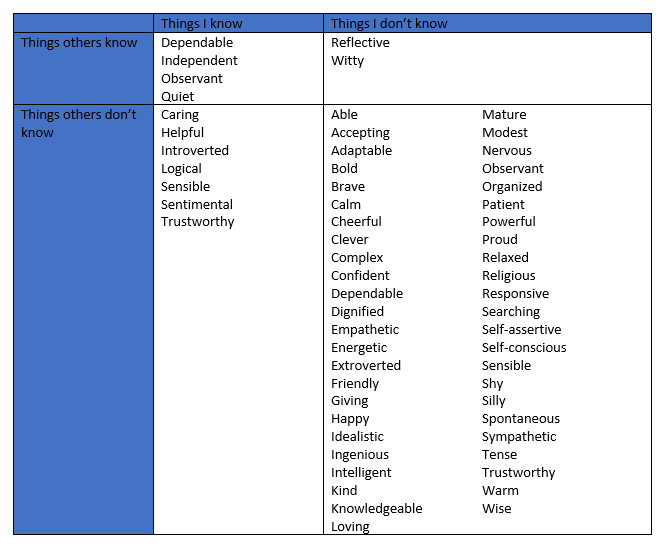
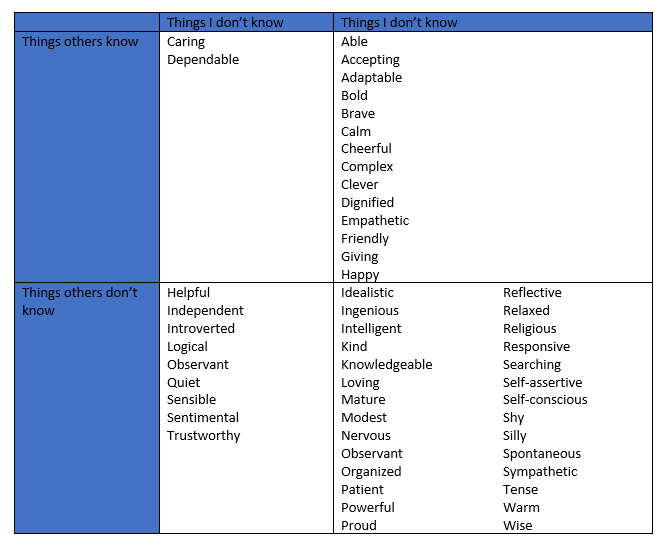
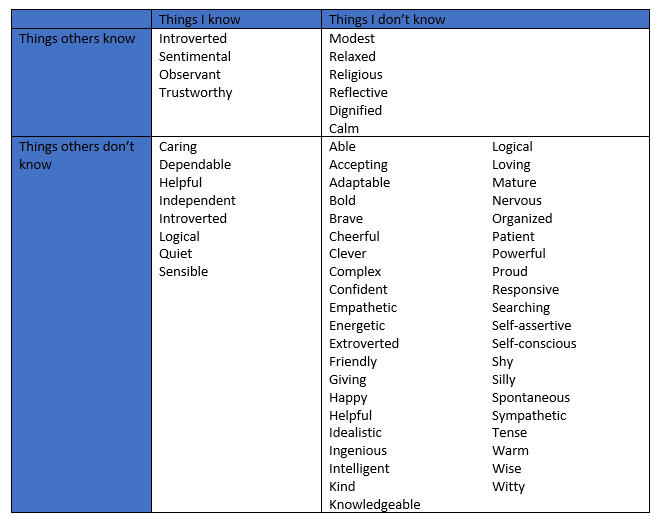
I got three friends that knows me for different time periods, 10 years, 5 years and 2 years. It looks like an accurate presentation of myself given the time periods that I have known them. I noticed that none of them have any traits that they all know of me.
I am actually surprised by Bing Zhong’s perception of me. However, he is different from the other two of them as he has some physical disabilities and it probably brought out some traits in me that no one else knows about.
How will it be useful for self-awareness and communication in a team?
I believe that the Johari Window Model is useful for self-awareness and communication in a team. If everyone in the team is open and honest to help each other complete the model, it can help an individual be able to understand the others and look to better themselves.
References: Communication Theory. The Johari Window Model. [online] Available at: https://www.communicationtheory.org/the-johari-window-model/ [Accessed 24 Jan. 2020].
 MGNT 102
You must be logged in to post a comment.